Sara Kerr

Musings

  • Normally, I have a no-texting policy in class, but last night was different.

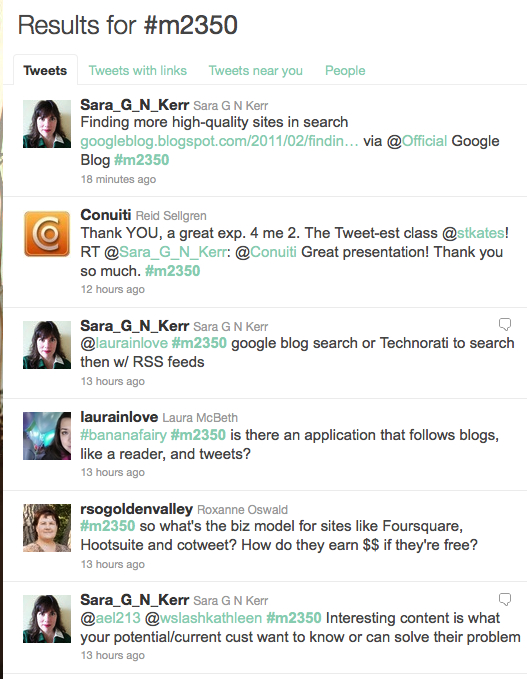
    In Promotional Communications / MKTG 2350 Integrated Marketing Communications, Reid Sellgren of Conuiti joined our class to discuss his work and trends in social media for business. As part of the discussion, my students and I tweeted questions back and forth using the hashtags #m2350 and #bananafairy.

    It’s always interesting to sit with your class and not stand up front to teach. Between Reid’s presentation and my iPhone Tweeted answers, my students took what they read this week about social media and used the technology they’d read about in class. It’s one thing to read about businesses using Facebook, Twitter, LinkedIn etc., but it changes your perspective and appreciation for the technology when you use it, as you learn it, real time.

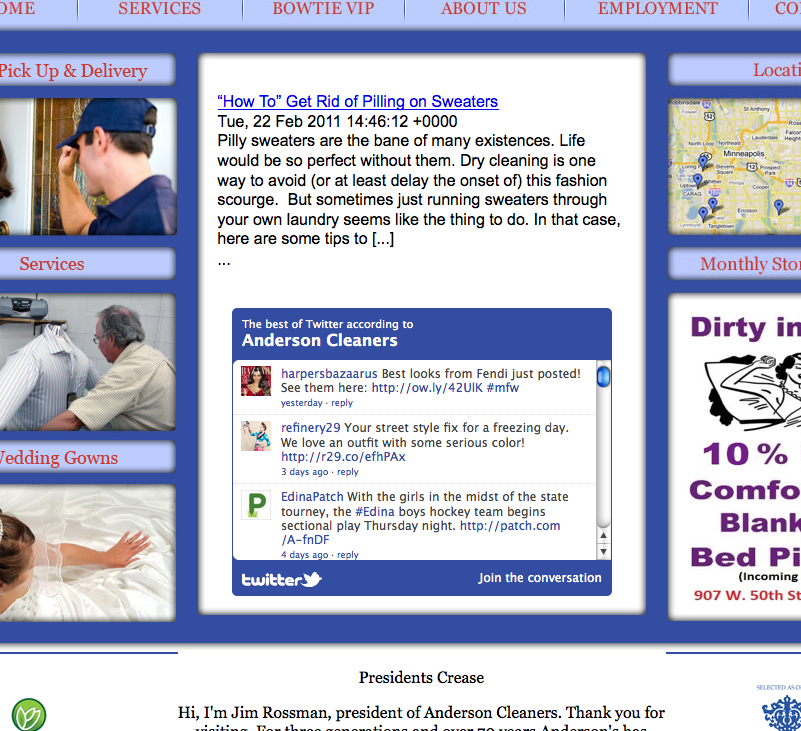
    Case in point, Reid’s company manages the fantastic, interactive marketing presence of Anderson Dry Cleaners. I’d never really thought about my relationship with my dry cleaner until I saw this website. Dry cleaning is just not fun, like shopping for a smart phone app is. But Anderson’s now my source for information — the stuff I need to know on caring for my clothes because of their content-rich website. Will that make me buy their services? Probably! Reid walked my students through Anderson’s website and its use of social media to enhance the customer experience and ultimately grow revenue. It was a fascinating experience augmented by Twittering through the presentation.

    Now, I’ll have to ask Reid what it likes looking out on a sea of faces pointed at their smart phones and lap tops. As a prof, that would unnerve me. As one of the Tweeters, it was an enthralling experience.

  • A smart student with great advice for small businesses.


    I was recently talking with a friend who’s owned her own business for some years now and works out of her home. So far she has a LinkedIn account and professional web page. My intention was to explain social media and how valuable blogging could be to her business. Her reaction came in long silences on the other end of the phone. I knew my well-intentioned marketing wisdom was not well received. So I started to ask questions to get to the bottom of her resistance. A few main objections surfaced:

    1) I don’t know what I would write about.

    2) I already spend too much time on the internet doing product research and what I love the most is being out in the field with my clients. I don’t want to spend any more time at my computer.

    3) The main objection: I work in a competitive, creative field where my colleagues have stolen clients. This is such bad behavior, why would I put my expertise out on the internet for free when I have been burned so many times before? People will want to get as much free information as they can and not hire me.

    All of her reasons are valid. For a small business owner blogging is scary, especially when you’re the only one paying the bills! I’ve responded to her doubts to dispel common misconceptions about blogging in the hope of helping others with the same concerns.


    Click the link below for her advice:

    Who’s Afraid of the Big Bad Blog?.

  • State Fair Fries

    Ah, I drove by the State Fair main gates last night and almost took a photo of the banner announcing 2011 fair dates. Yes, I know I could look them up online, but it doesn’t quite pack the same punch as seeing those dates in big, bold print when there’s 3 feet of snow on the ground (again.)

    Maybe I should blame the spurt of 40s we embraced, pranced and capered about in for my spring fever.

    But I’m not the only one.

    The gardening people recognize the symptoms and have mastered Integrated Marketing Communications.

    Weekly, John Scheepers Kitchen Garden Seeds emails me with helpful tips on growing plants from seeds at home, aka “content” in the vernacular of marketers. White Flower Farm sends me the most gorgeous paper catalogs every other month starting in December that make me pull out stickers and markers to note my favorites. The Friends School Plant Sale, my friend on Facebook, invited me to volunteer at the sale in May and submit photos of plants I’ve bought in the past — more great content.

    Just when I realized that my garden desperately needed peonies because of my White Flower Farm catalog, I read in the Star Tribune event section about the Minnesota Peony Society’s Peony Celebration at Bachman’s on February 26th. But my new favorite store, Eggplant Urban Farm Supply is offering the class Urban Chickens 101 on the same day. And there’s still space available!

    Gardening, plants, seeds, backyard chickens, and indoor greenhouse kits and how to use them are everywhere. But then that’s the point of Integrated Marketing Communications.

    Integrated marketing communications (IMC) is a process for managing customer relationships that drive brand value primarily through communication efforts. Such efforts often include cross-functional processes that create and nourish profitable relationships with customers and other stakeholders by strategically controlling or influencing all messages sent to these groups and encouraging data-driven, purposeful dialog with them. IMC includes the coordination and integration of all marketing communication tools, avenues, and sources within a company into a seamless program in order to maximize the impact on end users at a minimal cost. This integration affects all firm’s business-to-business, marketing channel, customer-focused, and internally directed communications. 1

    We all knew the February thaw would end and winter would return, but still, I saw grass on the edge of the sidewalk.

    And I’ve got seeds sprouting.

    1 Clow, Kenneth E.; Baack, Donald (2007). Integrated Advertising, Promotion, and Marketing Communications 3rd edition. Pearson Education. pp. 9–10. ISBN 9780131866225.

  • My working list of cool interactive tools for fun and business.

    Many are free or almost free except for the time needed to program, write, and monitor them. Here’s a great video (38 minutes) if you are really interested in working in social media.

    Pinterest — an online, virtual bulletin or pin board. It’s akin to liking something on Facebook that a friend shares with you. Login is via a Twitter or Facebook account. Different from Facebook, it curates your collections and makes them manageable

    • For use by:  a business or anyone with something they are passionate about
    • Purpose:  sharing what’s visually important to you
    • Method:  sign in with your Twitter or Facebook account, add “pins” which are visuals (photos, graphics etc.) that link to the web source, arrange pins in groups, called boards
    • Marketing Use:  drives people (traffic) to your website share your brand
    • Technology Requirements:  computer with internet
    • Consumer Issues:  none really. It’s incredibly easy and simple
    • Business Issues:  invitation only still…

    Here’s some expert advice from HubSpot and the Nonprofit Tech 2.0 blog.

    Paper.li — A Twitter newspaper and content curation system where you can publish on any topic you like

    • For use by:  a business or anyone with something they are passionate about
    • Purpose:  sharing what’s important to you and an easy place to read all about it
    • Method:  sign in with your Twitter account and then base the newspaper off of the posts of people, lists, keywords, and hashtags you follow.
    • Marketing Use:  a great tool to build followers
    • Technology Requirements:  computer with internet and a Twitter account
    • Consumer Issues:  none really. It cleans up the overwhelming native Twitter stream and presents new writers/experts that you may not have heard of.
    • Business Issues:  be specific with your curation settings if you are concerned with offending anyone. Here’s an example of a paper.li I manage for Good Ground Press.

    Google+ — A new social network

    • For use by:  a business or anyone with something to say, see Mashable on Google +
    • Purpose:  sharing — a lot like Facebook with added utilities:  better targeted sharing to subsets of one’s followers (aka “Circles”), chat feature (AKA “Hangouts”), multimedia sharing with photo manipulation similar to Instagr.am
    • Method:  Sign up with your Google account, share, build your network by adding people to your “circles.”
    • Marketing Use:  similar to Facebook for sharing and Twitter for news searching. Can also be used to conduct informal focus groups via “hangouts.”
    • Technology Requirements:  computer with internet
    • Consumer Issues:  can be confusing if you have more than one Google account and there is presently no way to combine them
    • Business Issues:  Time, mostly. How many networks do you need to be on? If your company is very techy and innovative, then this would be a good tool to use.

    Flickr – A photo-sharing service.

    • For use by:  a business that has something to show
    • Purpose:  awareness, share photos
    • Method:  post photos of business related work, e.g. framing jobs, new artists, new materials etc. for Frameworks, tag with business name, subject, location; as well as make albums
    • Marketing Use:  to keep one’s business top of mind, can also be used for contests, e.g. “Take a photo of yourself and product XYZ and post it to Flickr where ever you are in the world.” Should be referenced and linked in other social media and the main website.
    • Technology Requirements:  digital camera and computer with internet
    • Consumer Issues:  must have an account to upload photos
    • Business Issues:  Time, mostly. Can be quirky to link to a WordPress blog.
    • Example:  Element Six Media

    Instagr.am and others– photo sharing and manipulation via Twitter or Facebook; iPhone app

    • For use by:  a business or anyone that has something to show
    • Purpose:  sharing of photos
    • Method:  download app (free) from iTunes, share via Twitter and/or Facebook account
    • Marketing Use:  post photos of business related work, e.g. framing jobs, new artists, new materials etc. for Frameworks. Use Twitter handles and hashtags for business name, subject, location
    • Technology Requirements:  iPhone
    • Consumer Issues:  only available on iPhone:  Instagr.am, photogram, hipstamatic, GLMPS, Smugmug, Camera+ other platforms:  Posterous (Android, too), MobyPicture (almost all phones),
    • Business Issues:  much easier and faster than Flickr, but lower quality. Still, time to manage is always an issue. Click here to read why they are so popular.

    Foursquare – A location-based service. That means it only applies to a business that has an identifiable, physical presence that people come to.

    • For use by:  stores, restaurants, service providers, schools, libraries, etc.
    • Purpose:  build loyalty
    • Method:  “gamify” the act of visiting a place to make a purchase or do something
    • Marketing Use:  to encourage repeat business, reward customers who visit x number of times, become the most frequent visitor (aka the Mayor), or visit at specific times
    • Technology Requirements:  smart phone
    • Consumer Issues:  time-consuming to “check in,” can become irritating to constantly receive friends’ updates until you know how to turn that feature off, poor rewards
    • Business Issues:  not rewarding customers, setting up the account and then ignoring it, not integrating it into other marketing efforts, not responding to consumer comments

    Google Places – Google references businesses that people search for. Businesses can “own” these pages and update them with specific information.

    • For use by:  any business with a physical address
    • Purpose:  to be found
    • Method:  business owners let Google know that they own the business. Once ownership is verified by Google, the business owner can upload photos and adjust the map settings.
    • Marketing Use:  to encourage consumer searchers to click on your actual website and easily find your business on  a map. Business owners can also ask happy, loyal customers to review them. Positive reviews may sway potential customers.
    • Technology Requirements:  computer with internet connection
    • Consumer Issues:  owner provided pictures could be misleading
    • Business Issues:  owners should periodically update their listing, or at least check it, and monitor customer reviews.

    Online Business Directories — Many businesses are indexed (listed) by other businesses or service providers to help consumers. If a business has many alternates and is a type that is frequently searched, then strategically, the business should request to be included in any lists they find.

    • Examples:  http://www.mnschools.com/SchoolFinder/Preschools/index.htm#st.paul lists preschools in the St. Paul, MN area,  http://saintpaul.areaconnect.com/churches.htm lists churches, and Pauly’s List that lists senior-friendly businesses in the Twin Cities.
    • Purpose:  be found
    • Method:  business owners search lists online and then email list owners and ask to be included
    • Marketing Use:  simply to be found, but also found on influential lists
    • Technology Requirements:  computer with internet connection
    • Consumer Issues:  information can be outdated
    • Business Issues:  owners need to maintain a database of where they are listed and update the list owners as needed

    Google Alerts:  A Google service whereby one provides a search phrase, such as a business name to Google and then one is notified via email when Google runs across that phrase.

    • Examples:  I have one set up with my name, so that anytime references me on the internet, I’m informed
    • Purpose:  Monitoring or per Google:
      • “monitoring a developing news story
      • keeping current on a competitor or industry
      • getting the latest on a celebrity or event
      • keeping tabs on your favorite sports teams”
    • Method:  visit http://www.google.com/alerts
    • Marketing Use:  to manage one’s reputation
    • Technology Requirements:  computer with internet connection
    • Consumer/Business Issues:  turn around is slow — i.e. it make a few weeks for Google to let one know what they find.

    Yelp – an online review service

    • For use by:  any business that deals with the general public, i.e. B2C
    • Purpose:  word of mouth marketing in an electronic system. It’s a virtual place for consumers to read reviews from real people, share their positive opinion of a business, or vent their anger. For businesses, it’s another opportunity to “listen in” on what customers say about the business and, of course, manage their reputation.
    • Method:  Consumers can search without having an account, but an account is required to post a review. Business owners can claim their business in a similar fashion to Google places.
    • Marketing Use:  Word of mouth recommendations are highly trusted by consumers. Business owners can manage their reputation and interact with their customers.
    • Technology Requirements:  computer with internet connection
    • Consumer/Business Issues:  Negative reviews can potentially really harm a business. The best strategy for business owners is to bring the issue offline for resolution, i.e. never fight in public. Secondly, owners should encourage happy customers to review them on Yelp, to bury the negative review.

    Email Newsletters  – HTML emails

    • For use by:  Any organization
    • Purpose:  Opted in communication with an interested population
    • Method:  Encourage customers to sign up and provide email addresses, clearly state the privacy policy, reward consumers for providing this information
    • Marketing Use:  Share news, promote new products, thank customers, ask for feedback from the target population
    • Technology Requirements:  Computer with internet connection, email account, and/or an email marketing service account, such as MailChimp or Constant Contact
    • Business Issues:  Managing frequency (once a week is almost too much), providing content that customers are interested in, can be time-consuming to create the newsletter
    • Consumer Issues:  Information overload, tendency to simply delete all messages if too frequent or if the message is not compelling

    Blogs  – first person website, where writers share their opinions

    • For use by:  Anyone
    • Purpose:  Establish expertise, improve search (content quality and authority, social media links and content freshness.)
    • Method:  Open a WordPress account, buy a branded URL, learn the software, plan your topics, gather your writers, start writing, THEN start reading and commenting on blogs that relate to yours
    • Marketing Use:  web presence optimization (dominating the search results for your name and unique tagline), core of most social media strategies, to be found (see Purpose)
    • Technology Requirements:  Computer with internet connection, WordPress Account
    • Business Issues:  maintaining a regular publishing schedule of information that is appealing to your customers
    • Consumer Issues:  Information overload, the need to establish the accuracy of the writer

    Twitter – microblog to meet and connect people and organizations of interest

    • For use by:  Anyone
    • Purpose:  share news, learn things, talk with people, meet people
    • Method:  Set up account, learn the tool, start following people/organizations, share news/content (don’t sell), talk to people
    • Marketing Use:  Monitor what customers are saying about you or your company, or your interests; talk to consumers, respond to problems
    • Technology Requirements:  Computer with internet connection, Twitter account
    • Business Issues:  Time to Tweet frequently, finding  your voice (tone, subjects etc.)
    • Consumer Issues:  Information overload

    Facebook – Social network where people connect with people they already know, very personal

    • For use by:  Any organization
    • Purpose:  Opted in communication with an interested population
    • Method:  Engage with customers in their private space (vs. Twitter)
    • Marketing Use:  Share news, promote new products, thank customers, ask for feedback from the target population
    • Technology Requirements:  Computer with internet connection, Facebook account
    • Business Issues:  Managing frequency, providing content that customers are interested in
    • Consumer Issues:  Information overload, tendency to “unfriend/unlike” if feeling interrupted

    LinkedIn – online resume and network builder

    • For use by:  Any professional organization or person
    • Purpose:  Establish credentials, connect with colleagues, vet potential business contacts
    • Method:  Create personal and/or business account, populate it with accurate information that is found on a resume (person) or product offerings (business). Also join interest groups
    • Marketing Use:  Share news, promote new products, establish expertise, see purpose
    • Technology Requirements:  Computer with internet connection, email account
    • Issues:  Updating information, sharing news on a regular basis, participating in groups that one is a member of

    Groupon, Restaurant.com etc. — email/web-based heavily discounted offers to opted-in consumers

    • For use by:  An organization with something to sell
    • Purpose:  Create awareness, seek new customers
    • Method:  Create account with Groupon, PlumDaily, etc., design an offer that will entice consumers and not bankrupt the business
    • Marketing Use:  see Purpose
    • Technology Requirements:  Computer with internet connection, email account
    • Business Issues:  Must have limits on the offer because offer fulfillment can bankrupt a business
    • Consumer Issues:  Boredom with the offers

    RSS –  Really Simple Syndication

    • For use by:  Anyone
    • Purpose:  Simplified system of subscribing to content (website, blogs, newsletters, etc.)
    • Method:  Plugin to website or blog
    • Marketing Use:  Make it easy for consumers to opt in to regular information from you
    • Technology Requirements:  Some knowledge or access to expertise to set up
    • Consumer Issues:  Information overload, tendency to simply unsubscribe if too frequent or if the message is not compelling

    YouTube – Video blog

    • For use by:  Anyone
    • Purpose:  Establish expertise, appeal to people who prefer to watch and listen vs. read
    • Method:  Record and brand video, upload
    • Marketing Use:  Similar to blogging
    • Technology Requirements:  Computer with internet connection, video recorder
    • Business Issues:  maintaining a regular publishing schedule of information that is appealing to your customers
    • Example:  Element Six Media
  • If there is one word I don’t like and try not to use, it would have to be “stupid.” But today, I read something in the Star-Tribune that made me angrier than I am at all those people who deny climate change. So that’s why I’m using the “S” word

    Here’s a snippet of what I read:

    The latest push appears to be finding some support among Republicans, who now control the House and Senate and who see the ban as a government intrusion on personal freedom.

    “It’s really about freedom of choice,” said Sen. Michael Jungbauer, R-East Bethel, the proposal’s chief Senate author. “People have the choice to pick and decide if they want to go to a bar or restaurant that allows smoking or doesn’t allow smoking.”

    My response? What about all those servers, bartenders, barbacks, cleaners, managers etc. who also want the freedom to breathe clean air? Don’t they deserve that freedom? Workplace safety is not a choice, it’s a right.

    Anyone has the right to smoke, but they don’t have the right to poison other people’s lungs.

    So what does this have to do with marketing?
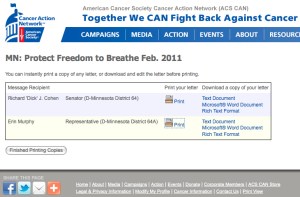
    Let’s check in with the Minnesota branch of the American Cancer Society Action Network. On their website, they ask Minnesotans to “MN: Ask Your Senator to Protect Freedom to Breathe.”

    You fill in your contact information and then a letter is generated to your Minnesota senator. It’s not hard to do, but it’s not very intuitive either. Once you complete the form, you go to another page to print your letters. At the bottom of the page, there are links to share it on Facebook etc. I tried it a couple of times and oddly, different representatives came up each time. First Senator Richard Cohen and then Representative Erin Murphy. The form letter was different, as well. This made me think, well why don’t I get to choose to whom I should send the letter to? Is there someone else I should contact?

    Effective marketing? C+ for making an effort.

    Social Media, well the American Cancer Society does have a Facebook fan page, but there’s nothing about Minnesota and their opposition to House File 188/Senate File 168. And Twitter, well no Twitter feed either. The American Cancer Society Action Network, tweets, has fans, and shares video, but I can’t figure out how they are related to the American Cancer Society. On a side note, I do love their tagline:  the Official Sponsor of Birthdays. What fabulous positioning.

    I’m doing my best to make up for that though–please Tweet this and include the hashtag #MNSmokingBan so we can raise awareness — a principle goal of good marketing.

    Further Reading:

    Stand up Against Smoking in Bars by Dawn Aberle

    Now, many communities have fines if your dog takes a dump and you don’t pick it up. I highly doubt there are very many people who shout “my dog has a right to do whatever he wants wherever and whenever he wants!” Nor would many be happy to utilize public bike paths and parks and be subjected to the smell or even to step in it.

    So as I leaned down to pick up my dog’s pile of steaming poo, I realized I can hold my breath for a little while, and if it gets on my shoe, I can scrape it off and go about my day. I can’t do that with secondhand smoke.

    Clearing the air in Minnesota By Taryn Wobbema and Jeremy Olson

    The survey, conducted every three years by the Minnesota Department of Health, suggests that the state’s controversial 2007 indoor smoking ban has produced a dramatic shift in Minnesotans’ thinking on the hazards of cigarette smoke.

    How dramatic? A majority of smokers now refuse to smoke in their own homes, the survey found.

    PUBLISHER’S NOTEBOOK: Regulation may be a burden, but can also provide a benefit By David Phillips

    However, the major part of the controversy in 2007 was on the ban’s impact on bars and restaurants as there were fears it would drive them out of business. A separate study by the University of Minnesota indicates that the smoking ban hasn’t caused economic harm. An analysis of employment data from 2004 to 2008, the latest data available, showed no sign that the legislation hurt hiring in that industry.

    Review of Economic Studies on Smoking Bans in Bars and Restaurants by Donald Hirasuna, Legislative Analyst

    Almost all the reviewed studies reported, on average, no net loss and sometimes net increases in bar or restaurant sales after smoking bans went into effect.  These estimates are for total sales and for the proportion of sales within a county.

  • My personal favorites, in some particular order…

    1) The Current

    A snippet about their recent birthday party from Chris Riemenschneider at VitaMN.com, the arts and entertainment weekly from the Strib. Click here for City Page’s review. We are so lucky and the show really was awesome.

    Four of the five acts playing the Current’s Sixth Birthday Party have filled First Ave on their own, so the soiree is sort of a wham-bam thank-you overview of numerous weekends at the club. The acts certainly owe gratitude to the nonprofit radio station for making those gigs possible. And the station owes a giant thanks to the music scene for making it something more than just another Radiohead-spinning hipster rock outlet. Not that there’s anything wrong with that. Trampled by Turtles will open the show — late arrivals, be damned! — followed by Roma di Luna, Jeremy Messersmith, Free Energy and Brother Ali.

    I suppose I should say why this is amazing marketing. All you have to do is go somewhere else in the US and turn on the radio. Public radio stations typically have talk and classical music formats. Commercial stations are naturally dependent on advertising and are excruciatingly format driven. Is this target marketing at its worst? Are musical tastes really that “siloed?”

    About 6 years ago, MPR purchased a beloved and unique public radio station in Minnesota. People were mad. Then people were shocked — happily — to hear this new station. And it’s only gotten better. Where else can you regularly hear local music on the radio and then go see them perform live — all the time?

    2) The Pillsbury Doughboy. Seriously, I’ve loved him since I was 3. Why doesn’t he have his own YouTube channel, though?

    Tara Jarmon for Target

    3) Target’s Guest Designers. Where else can you buy toilet paper AND William Rast denim? Target’s Go International brings innovative new designers to my neighborhood big box. I need Tara Jarmon’s reissued dress for the spring!

    I would not be able to find this anywhere else, so why would I go anywhere else? Doesn’t it save me time to combine all my shopping into one, big trip? Time, maybe…

    4) Minnesota Professional Sports. Here’s how I sum them up:  We live in the State of Hockey, we love to hate the Vikings (and the Dome), and we play baseball outside in Twin’s Territory. How could you not love that?

    5) Winter. From the surreal beauty of the City of Lakes Loppet, to quaint and campy St. Paul Winter Carnival, and the St. Paul Parks and Rec ice rinks, but especially the one at Groveland Park; we love winter. Yeah, not just LIKE it, but love it. We’ve turned the terror of 20 below into thinking 32 in February is a heat wave. I can’t begin to explain to a non-Minnesotan how incredible 33 degrees feels in the middle of winter. You have to live here, a long time, to feel that way. But we don’t want to get it too much warmer because then the sledding hills will turn to mush and the ice rinks will get choppy. Thank goodness for the refrigerated ones

    A BIG THANKS to all my students who offered me their own Minnesota Marketing Faves when I got stuck on the Pillsbury Dough Boy (and his Crescent Rolls).

  • I LOVE this ad. Probably my favorite from the game (so far…there are 10 minutes of play left).

    Do YOU like it? What makes it great? I have my opinion, but I’d like to hear yours.

  • Great advice, beautifully presented from a local, blogging star.

    4 ways to stand out from the crowd in your marketing job search When stacked against tens or even hundreds of candidates for desirable positions, candidates need to find creative ways to stand out from the crowd.  How you present yourself makes a big difference in how memorable you are and the likelihood that well-connected people will hire you or recommend you for positions. From networking to interviews, here are four ways all professionals – young and experienced – can stand out from the crowd: 1. Business … Read More

    via Marketing Insights and Inspirations

    The business card design I use comes from Seth Godin — my contact information and passions on one side and a cool Godin quote on the reverse. You can purchase them here from Moo.com, a funky UK print shop with a U.S. affiliate. The cards are a great tool, especially when your first and last names are super common, like mine!